I’m not sure if this is funny or just horrifying…
Categories
I’m not sure if this is funny or just horrifying…
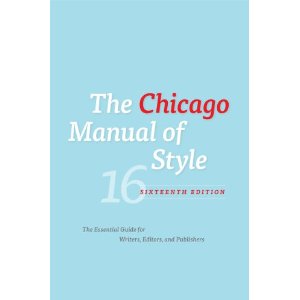 I’ve recently seen a number of manuscripts and blogs with double spaces after terminal punctuation (periods, question marks and exclamation points at the end of a sentence). I remember learning to do that way in a very long ago typing class, and I’m sure that’s where these writers learned it as well. However, times have changed.
Now that computers offer proportional typefaces, rather than the fixed-width Courier, it is correct to space only once after a sentence. Double spaces make unattractive gaps or “rivers of white space” down the page, and prevent the manuscript from looking professionally typeset. It may be a hard habit to break, but it’s worth it.
If you’re still a little dubious, or if you have a typing manual or teacher who still admonishes you to space twice after terminal punctuation, you may want to refer to the ultimate authority, The Chicago Manual of Style. The recently published 16th edition addresses “period/single space after” in sections 2.9, 2.11, 6.7. If the CMOS decrees it, you can be assured that it’s so! If you don’t have this edition on your shelf, you can sign up for a free 30-day trial online and see it for yourself.
In a recent workshop a student asked, “What is the best way to start writing a story?” Though I was tempted to prescribe composing in purple ink on a yellow legal pad while sitting in a green leather chair in a room with exactly seven windows, I settled on sharing a bit about my own fiction writing process.
I do a lot of thinking before I ever start to write. Storylines and characters form, shift, and morph until I finally begin to make notes. I keep paper and a pen in every room of the house, and scribble down scenes, descriptions, and dialog fragments that arrive.
Once I feel that I know the characters fairly well, I begin transferring character and scene notes into StoryBlue (software for writers). This always feels like the first official step in establishing structure, but it’s not yet the beginning of writing.
Sometimes my writing process seems to stall at this point and I’ll turn to other projects. The story simmers at the back of my mind until a perfectly formed first line* presents itself. As soon as it arrives and I write it down, the story starts to unfold, scene after scene.
I’ve tried writing without the magical first line, but find that until it arrives I struggle to capture the voice of the story. It’s almost as if the story elements have to go through a process of ripening before they’re ready to be written. For me, that luscious first line is the beginning of a writing harvest.
So… how do you start writing fiction? NaNoWriMo is coming up, so now’s a good time to start thinking about it!
*The first line may change by the end of the book, but at the moment of beginning, it’s perfect for its purpose.
 I just talked to Jerry Simmons, NAIWE’s publishing expert, and came away with some interesting insights into the expectations of publishers. I suspect that there are more than four things that publishers want authors to bring to the table, but the ones that Jerry chose were based on his own vast experience in the business side of the publishing world. A couple of them surprised me– how about you?
Here are Jerry’s picks for four indispensable ingredients for publishing success:
Publishers are in the business of producing content that they can sell. If you write decently and can turn in at least a manuscript every year, a publisher is more likely to value you.
Stick to your area of expertise, and turn in good quality work each time. If you’ve gained an audience for a particular type of work or in a particular genre, write for your audience. It not only keeps your backlist alive longer, but it’s also easier to sell to an established audience, rather than having to build an entirely different audience. If you feel you must write in other genres, you may want to get a different agent and use a pseudonym. According to Jerry, publishers regard commitment and consistency as a huge plus, and that can have a positive impact on your writing career.
No, this isn’t quite the same as being consistent. Predictability actually has to do with percent of predictable sales. If a publisher ships out 1000 copies of your book, they want at least 65% of them to sell (the ones that don’t sell are returned from the bookstore to the publisher to meet a dismal fate). Publishers also like to see your backlist continue to sell (the backlist is books that are over about six months old). If your work consistently sells at a high percentage rate, you’ll be considered a publisher’s gold mine, and you’ll benefit from the multiple streams of royalty income.
The best way to sell books is through publicity. Are you presentable and articulate for book signings or radio and television interviews? Remember, you’re representing not only yourself, but also the publisher, so they need to be convinced that you won’t embarrass them, and that you’ll effectively participate in the marketing of your book. Marketability can weigh quite heavily in a manuscript-purchasing decision, so take a close look and see how you can make yourself more marketable.
You may decide you need to get a media coach or join Toastmasters International to learn about speaking, or get your teeth whitened, a fresh hairstyle, or perhaps just a nice outfit or two (get good advice from a professional who understands business wear). Whatever you do, it will be an investment in marketability which can further your writing career.
There… what do you think? Were you surprised by any of these items? I’d love to hear your thoughts.
You can listen to the interview on NAIWE NewsWire.
I’ve recently gotten a couple of small payments from Demand Studios (in the $5-10 range), and because I’ve been rushed, didn’t figure out until today who they are and why they’re sending me money. Of course, I’d have been on it much faster if they were billing me for something I didn’t recognize!
I submitted an article to the eHow network last year, just to see if it might be another viable stream of passive income. They’re apparently part of Demand Media, so that’s the who and the why. I just didn’t recognize the name.
I realize there is a lot of debate as to the wisdom of these work-for-hire arrangements, but because I teach the Multiple Streams of Income for Writers classes, I felt it would be a good idea to check it out. Anything in the name of research!
Based on this small sample, I can’t say whether or not it’s worth trying, so I’m going to add a total of about ten articles and see what happens. The biggest caveat is that it’s a work for hire system, so you retain no rights to your work. This was irrelevant to me, as the topic I wrote on was not one of my primary teaching topics, so I don’t anticipate ever wanting to reuse it. If the articles sit there and continue to generate passive income, it just might be worth it. I’ll let you know!
 So, what do you do when you think you want to get something published?
Here are a few tips for where to start when you have something to say and want to see it in print.
If you’re serious about getting published, join a writers’ critique group and get feedback at a local level before submitting. Other writers can see things you’ve missed, ask questions that help you clarify what you’ve written, and just offer good advice for the journey. You don’t have to take all the advice you receive, but you’ll find your work strengthened by the exposure to feedback from other writers.
If you’re not absolutely confident that your grammar, punctuation, and word usage are extremely good, hire an experienced copyeditor to clean up your manuscript before you submit or self-publish. Traditional publishers want to see material that is close to publication-ready. Editing is time-consuming, so don’t expect to get a good job free (unless you’ve married an editor;-)).
If you want to be published traditionally, learn about the industry. Read writing magazines; read a lot of good work in your genre; get Writer’s Market and learn about the submission process; and go to writer’s conferences and workshops. In any field, it’s necessary to learn and practice the basics before you can expect to succeed. You probably wouldn’t expect to be hired as a symphony violinist if you’ve taken only six weeks of lessons, so it’s reasonable to assume that there’s a learning curve for the writing and publishing process as well.
Accept the fact that there are standard procedures and timetables in the publishing industry, and you can’t change them. Stephen King or J.K .Rowling may be able to get special treatment, but novice writers needn’t expect anything special. It pays to learn to learn about the industry so that you won’t accidentally sabotage yourself through impatience or lack of knowledge.
Get involved with the writing/editing/publishing industry. Join a writer’s association such as NAIWE, the National Association of Independent Writers and Editors, where you’ll learn a lot more about writing, editing, publishing, and marketing your work.
Finally, enjoy the process. It can be challenging and frustrating at times, but writing is worth it.
 I’ve been reading Just Do Something: A Liberating Approach to Finding God’s Will or How to Make a Decision Without Dreams, Visions, Fleeces, Impressions, Open Doors, Random Bible Verses, Casting Lots, Liver Shivers, Writing In the Sky, Etc. by Kevin DeYoung. I picked it up at a recent conference, not because I have trouble with decision-making, but because I’m a sucker for a catchy title (there’s a lesson there for publishers).
It’s a solid little book that takes a serious look at the harm done by indecision, waffling, inconsistency, and the unwillingness to just put a hand to the proverbial plow and get moving. Spiritualizing indecision and inaction may make it more socially acceptable, but it doesn’t make it a more effective life strategy. Just Do Something is more than just a title, it’s a strategy that works.
How does this book relate to writing and escaping the slush pile? Take a minute to read Stephanie Blake‘s inspiring blog post, “How I (Finally) Got a Book Plucked From the Slush Pile,” to get a good look at exactly what “just do something” looks like in the writing world. Stephanie chronicles a year by year saga of her long road to publication heaven, and the thing that stands out is that she simply kept doing something.
Like many unpublished writers, she learned through the process–through slammed doors, frustrating rejections, and tantalizing “almosts.” She went to conferences, worked with agents, did revisions, and did it all again and again. She didn’t wait for the stars to align, for approval from others, or for anything else before she started sending out her work. She sent and sent and sent. She revised. She sent some more. Finally the miracle happened, and The Marble Queen was plucked from the slush pile and accepted.
If she hadn’t written this blog post, there would have been unpublished writers who commented enviously about luck and overnight success and people who get all the breaks (I know, I’ve heard all that– many times, and if you’ve been through Lucky Freelancer coaching with me, you’ll know exactly how to turn those excuses upside down). There’ll probably still be writers who say things like that, but that’s because they’re not out there doing something. They’re just a little too busy–way too busy–to do all that sending and revising and resending, but one day, just watch, they’ll get the call too. Or not.
The fact is that just do something is the key to almost everything. The book is good too. I’ll be sharing it, so don’t be offended if I send it your way. Just do something!
I had a few rough ideas of what I’d like to accomplish for the NAIWE 2010 Get it Done Summer Challenge. If you haven’t checked it out, the three parts of the Challenge are:
I read Sheri McConnell’s Smart Women Know Their Why (see review in the preceding post) for the first of my three books, and have a teetering stack from which I can choose the remaining two official Challenge books. This is the easiest part, because I know that before summer is over, I’ll have read quite a few more than three books. I schedule morning and evening reading times so that I can bracket each day in knowledge, inspiration, and sometimes, just plain fun.
The second element of the Challenge was to finish a nagging project. I finished a huge one just a few weeks ago, so considered counting it and coasting on this option. However, another nagging project has been to learn more about financial management, retirement planning, and all that goes into being a good steward of resources. So that got added to the list for Part 2 of the Challenge.
The final challenge piece is where serendipity kicked in. I brainstormed a great list of projects that could bring in an additional stream of income (some of them would also qualify as nagging projects), and was trying to decide which to pursue when a brand-new project dropped into my lap. Serendipitously, it happens to fulfill not only the final element of the Challenge, but the second as well.
For Part 3 of the NAIWE challenge, I’ll be producing a book on personal finance and estate planning. I just love serendipity! The author has provided a large collection of written work that needs to be transformed into a book and prepared for publication (compilation, editing, layout, cover, etc.). I’ve begun to work with it, and I can already tell I’m going to learn a lot about finance. It’s also going to be a very large project with a very short deadline, so I’m scheduling the rest of the summer pretty tightly. I’m grateful to have such an interesting project come my way, and doubly delighted at the serendipity of it all.
So…what are you doing for the NAIWE Summer Challenge?
I occasionally want to refer someone to these amusing “rules,” so I decided to post them here for future reference. Enjoy!
I believe they were written by William Safire, but am not positive. If you know for sure, please feel free to comment!
I was lucky enough to pick up a few gently used writing magazines from our library’s give-away basket a couple of weeks ago. As I read them, I was reminded of the college textbooks I’ve occasionally bought and sold online. Often, when I’ve purchased a textbook from a user who mentioned getting an “A” in the class, the book has been in “acceptable” condition. There is writing in the margines, sticky notes fluttering from various pages, and very obvious signs of use. In contrast, I’ve also received books in pristine condition with unblemished pages, sharp corners on the covers, and no sign of ever having been opened.
Somehow, I feel that the crisp, near-new magazines I picked up and those unused textbooks have a lot in common. In order to benefit from the knowledge and experience in any book or magazine, I’ve found that I have to interact with it. I need to read, absorb, analyze, perhaps argue, and finally, I need to apply what fits. Readers who are unwilling to “mess up” a clean page with notes and underlining may be missing essential knowledge.
Just think: If someone makes a habit of sitting down to a meal, glancing at every dish, perhaps tasting one or two, then getting up and clearing everything away, that person wouldn’t be healthy for long. Similarly, someone who skims a writing magazine isn’t going to have a healthy writing career until he or she chooses to absorb and apply available knowledge.
If you want to get the most out of a writing magazine, here are seven suggestions:
It’s nice to be able to sell a pristine textbook or give away an almost new magazine, but the really valuable book or magazine is the one that has been read, absorbed, and used. To extract the most good from your writing magazines, study them and make them your own. You can’t become a writer just by reading a magazine, but you can become a better writer by actively learning from others who know something that you don’t know.
If you’ve reached the stage when you feel that you know all you need to know, do a quick career check. If you’re living the writing life you’ve always wanted, earning the income you believe you’re worth, then you may be right. If not, keep learning and growing. There’s almost always room for improvement!
Some books are to be tasted, others to be swallowed, and some few to be chewed and digested:
that is, some books are to be read only in parts, others to be read, but not curiously,
and some few to be read wholly, and with diligence and attention.
Francis Bacon